Here’s what most franchise disclosure documents don’t tell you upfront: the number on the cover page is just the beginning. If you’re working through How to Start a Food Business with a Franchise, the real skill isn’t hunting for the lowest fee — it’s understanding what each dollar is actually purchasing. Some costs build your foundation. Others just fill someone else’s margin. Knowing the difference matters enormously, especially when the money you’re putting in represents years of discipline and your family watching closely.
“The first thing an experienced operator looks at isn’t the franchise fee — it’s what happens after you pay it. That’s where the real story lives.”
The How to Start a Food Business with a Franchise Line Items That Actually Matter
A solid franchise startup package breaks costs into distinct buckets. Most people focus on the initial franchise fee — typically $25,000–$50,000 in the fast casual space — and stop there. That fee is really just your license to operate. Here’s what the rest of your investment is doing:
- Build-out and leasehold improvements: Usually the largest single cost — $80,000–$180,000 depending on the space condition and your market. In Cleveland, costs shift noticeably between a quiet suburban strip and a high-foot-traffic corridor.
- Equipment package: A good franchisor bundles this with pre-negotiated, vendor-approved pricing — not a situation where you’re shopping for a commercial refrigerator alone at 11 p.m.
- Initial inventory: For a Mediterranean fast casual concept, this runs meaningfully lower than a full-service kitchen. A focused menu keeps opening inventory lean by design.
- Technology and POS systems: Expect $5,000–$15,000 for point-of-sale hardware, online ordering integration, and a training environment.
- Working capital reserve: Three to six months of operating expenses. This is the number most first-timers underestimate — it’s your buffer while you build volume, not a contingency you hope never to touch.
- Training program: A legitimate franchisor includes this in the package — pre-opening training, on-site launch support, and ongoing operational guidance. If it’s an add-on cost, that’s a flag worth noting.
Warning Signs in a Franchise Cost Breakdown
Before you read the Franchise Disclosure Document requirements from the FTC, understand that not every franchisor structures costs in your favor. Experienced operators catch these early:
- Vague “grand opening marketing” fees with no defined deliverables
- Equipment sourced exclusively through one vendor with no pricing transparency
- Training described in hours rather than outcomes — “40 hours” means nothing if it’s all classroom and zero floor time
- No clarity on what ongoing support looks like after month one
These aren’t reasons to walk away — they’re reasons to ask harder questions. Read more about red flags to watch for when comparing food franchise opportunities before you reach the signature page.
Why Mediterranean Fast Casual Sits at a Different Entry Point
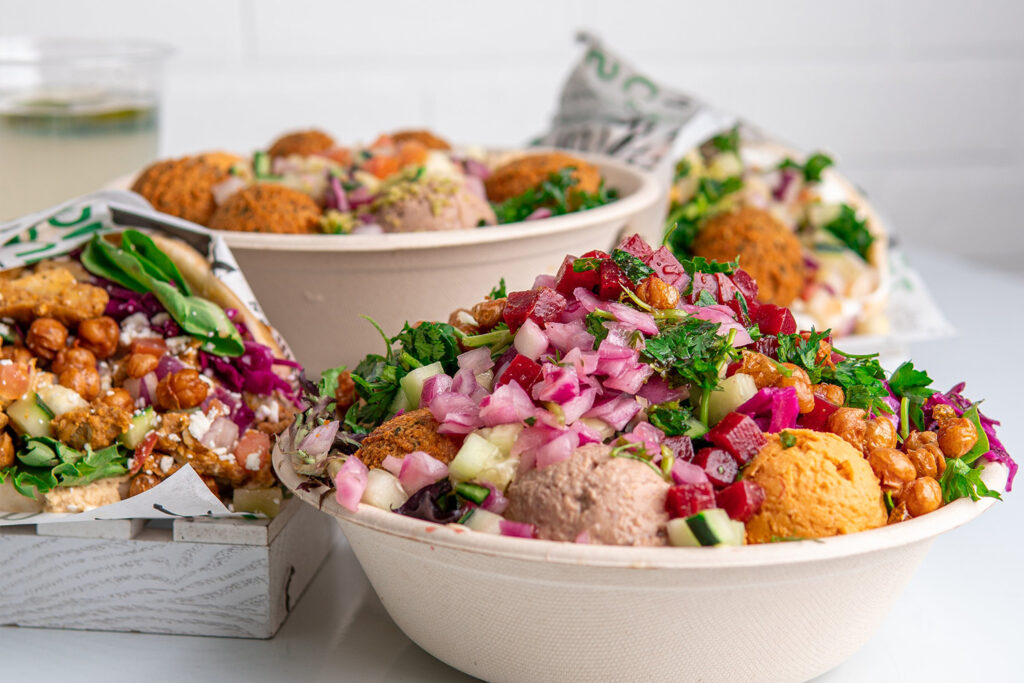
If you’ve been researching how to open a Mediterranean fast casual restaurant in Cleveland or OH, you’ve likely noticed this category costs less to enter than legacy QSR brands. There’s a structural reason: the menu is focused, the equipment footprint is smaller, and the food — hummus, falafel, fresh pita, grilled proteins — doesn’t require complex kitchen infrastructure. That’s not a compromise. That’s a simple, focused menu working as a genuine competitive advantage.
Total investment for a Mediterranean fast casual franchise typically falls between $150,000 and $350,000 all-in, depending on market, space condition, and ownership model. Legacy burger or sandwich franchises routinely demand $400,000–$700,000+. That gap changes what’s financially possible for a first-time owner in Cleveland building without outside investors — and it’s one reason the category keeps growing.
Understanding startup costs is step one. But owners who build real equity think further — they consider how franchise ownership builds net worth over time, not just monthly income. The cost breakdown matters because it tells you whether the system is designed for your success or theirs.
At Hummus Republic Franchise, we built the model around lowering the barrier — transparent costs, real pre-opening training, and support that doesn’t vanish once the doors open. Ready to see real numbers for your situation? get in touch or request your free franchise info package below.
Some content on this site is AI-assisted and may not reflect exact current details — please verify with Hummus Republic Franchise at . Learn more.