You opened one location. You figured it out — the early mornings, the staffing puzzles, the moment you realized you actually knew what you were doing. And now, quietly, you’re asking the question that comes next: can I do this again? Learning How to Grow from One Franchise to Two Locations is less about hustle and more about building the right system the first time — so the second location doesn’t require you to start over from scratch.
Why the Jump to a Second Location Feels Harder Than It Should
Most franchisees don’t burn out because they lack drive. They burn out because their first location was never set up to run without them. If you’re the person who opens the doors, manages the line, approves every order, and locks up at night — you don’t actually own a business yet. You own a job with higher stakes.
That distinction matters enormously when you’re thinking about the difference between owner-operator and semi-absentee ownership. Expanding to two locations while running the first one like a one-person show is a reliable path to exhaustion. The solution isn’t waiting until you feel ready. It’s building systems at location one that let it function without your constant presence.
Build Location One to Run Without You First

Before you sign anything for a second unit, ask yourself honestly: could your first location operate for a full week if you weren’t there? If the answer is no, that’s the work. Here’s what needs to be in place before expanding a food franchise to multiple locations becomes viable:
- A trained, trusted manager who owns the floor and makes real decisions. (Read more about how to hire a manager who actually runs the location for you.)
- Documented SOPs — not just in your head, but written out, trained on, and tested.
- Consistent unit economics — stable food costs, predictable labor, and a clear picture of your margins. If you’re not sure what healthy numbers look like, understanding what good unit economics actually look like is worth your time before you commit.
- A supply chain that doesn’t depend on you — meaning vendor relationships, ordering schedules, and inventory systems are all operator-independent.
The franchise that scales isn’t the one with the hardest-working owner. It’s the one with the most repeatable system.
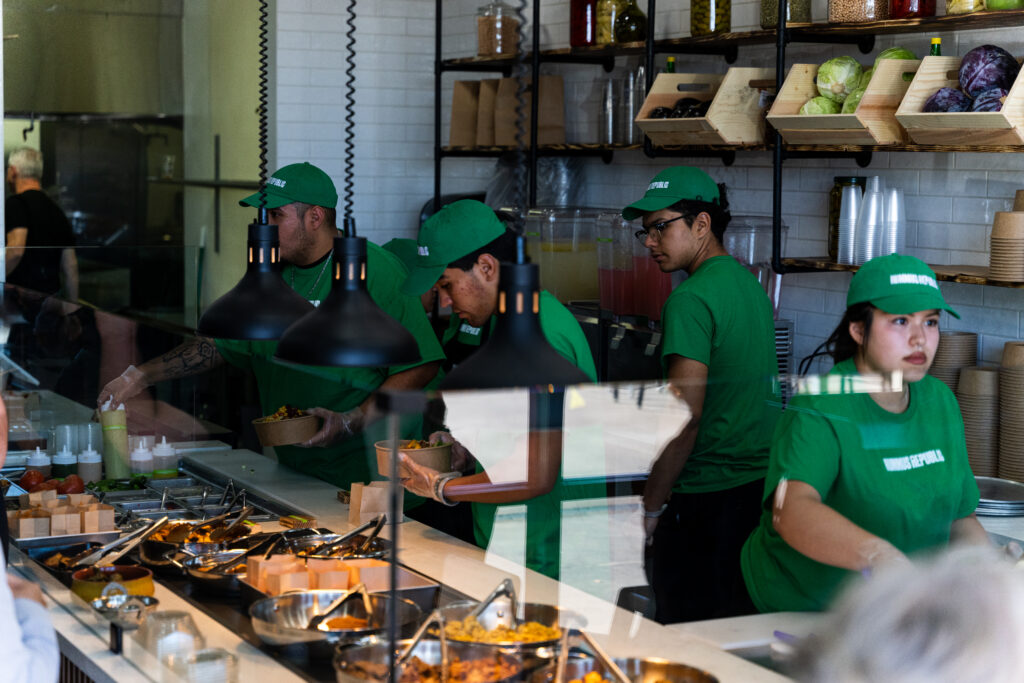
This is one of the reasons a fast casual franchise with a simple, scalable model changes the math so dramatically. When the menu is intentional, the kitchen flow is tight, and the supply chain is centralized — you’re not reinventing the wheel at location two. You’re copying a blueprint that already works. That’s a real structural advantage, not marketing language.
The How to Grow from One Franchise to Two Locations Reality in a Market Like Cincinnati, OH
Think about the density and diversity of a city like Cincinnati, OH. In Cincinnati, neighborhoods like Over-the-Rhine, Hyde Park, and the Kenwood corridor each carry distinct customer profiles. A second location doesn’t have to feel like a clone — it can be positioned differently while running on the exact same operational backbone. That’s what protected territory agreements are designed for. Understanding territory protections and what encroachment actually means is one of the conversations worth having early, not after you’ve already signed.
There’s also a practical financial question: how do you fund a second unit without overextending? SBA loans structured specifically for restaurant franchises are one path many multi-unit owners use. Others leverage the equity they’ve already built in location one. The key is having a franchisor who helps you map those options — not one who hands you a disclosure document and goes quiet.
What Buying a Second Food Franchise Location Actually Requires
The emotional shift is just as important as the operational one. Going from one to two means accepting that you are now managing managers — not managing shifts. Your job changes. You’re thinking in systems, not in hours. Owners who make this transition well tend to share a few things:
- They treated location one as a training ground for leadership, not just operations.
- They got financially clear — they knew their break-even timeline and their actual margins before they committed to anything else.
- They chose a brand with a real support structure, not just a manual and a phone number that goes to voicemail on weekends.
- They thought about what they were building beyond the next lease cycle — understanding how to eventually build and sell a franchise at a profit is part of thinking like an owner from the start.
The families who build something real — something they can hand to the next generation — are the ones who understood early that the business has to be bigger than any single person inside it. That’s what raising entrepreneurial kids inside a family business actually looks like in practice: you build something that outlasts your daily presence in it.
At Hummus Republic Franchise, we’ve built the model around exactly this kind of growth — streamlined operations, a centralized supply chain, and the kind of support that doesn’t disappear after opening day. If you’re in Cincinnati, OH and you’re seriously thinking about a second unit, we’d love to talk through what that path looks like for your specific situation. Get in touch through our contact form and let’s have a real conversation.
Some content on this site is AI-assisted and may not reflect exact current details — please verify with Hummus Republic Franchise at . Learn more.